

About | Copyright © 2026 Budapest University of Technology and Economics

BUDAPEST UNIVERSITY OF TECHNOLOGY AND ECONOMICS
Faculty of Electrical Engineering and Informatics
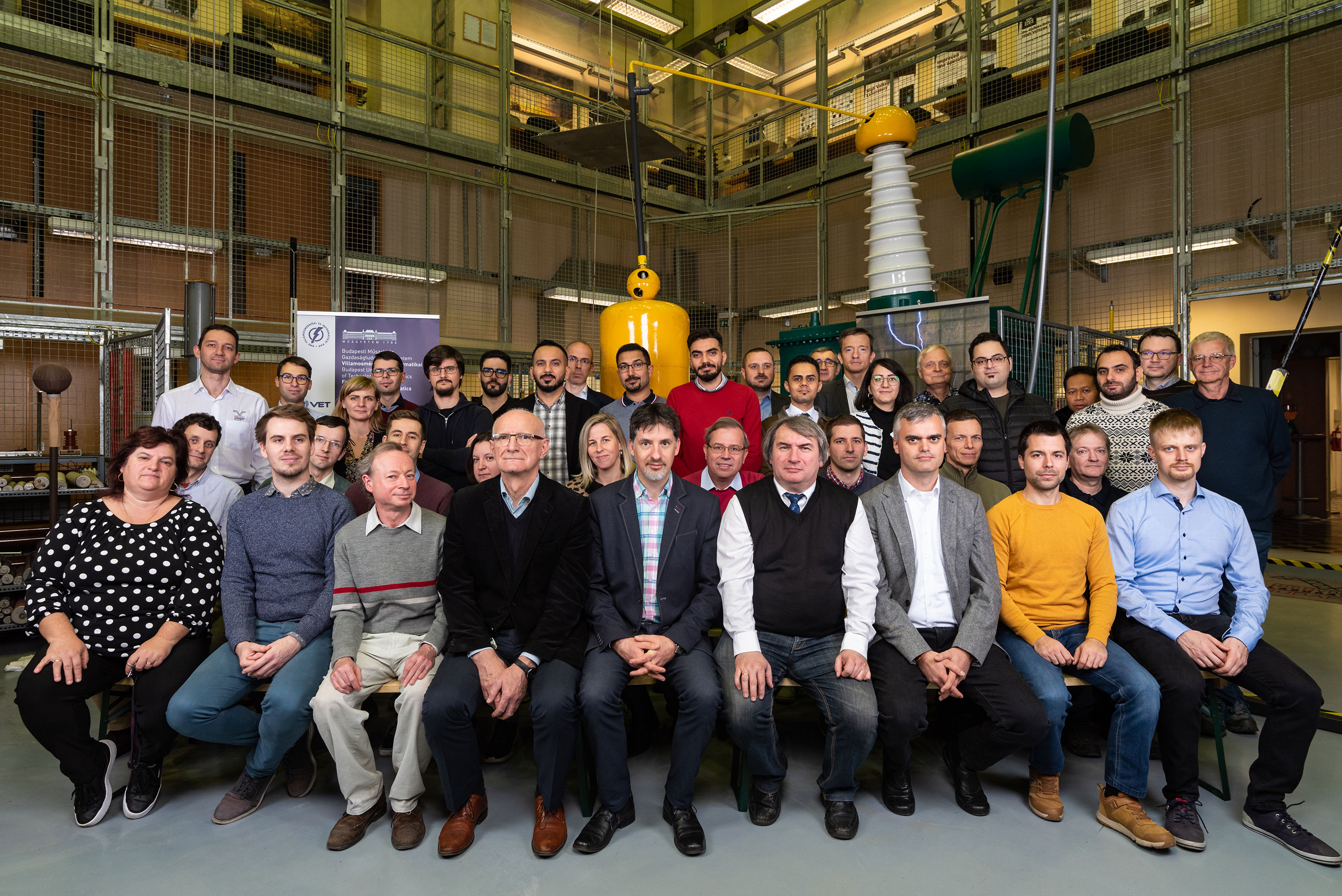
High Voltage Laboratory – Department of Electric Power Engineering

1893–1907 In 1893, the Department of Electronics of the Technical University (then the Royal Joseph Technical University) was founded, headed by Károly Zipernowsky. Hungarian electrical engineering already had a significant history by this time: in the 1860s and 70s Ányos Jedlik created the tube-type electrostatic generator, essentially the ancestor of the impulse voltage generators still used today, and in the 1870s and 80s Károly Zipernowsky, together with Miksa Déri and Ottó Bláthy, carried out the development of the transformer, an innovation of major international significance. The "FE" building (today's building F) for physics and electrical engineering was handed over during the 1906/1907 academic year. Zipernowsky equipped its lecture hall and laboratory with modern machinery and equipment. Thanks to the excellent teaching staff and the state-of-the-art equipment, electrical engineering education and research at the Technical University were already world-class at this time. 1929–1945 On 21 August 1929, following his earlier industrial successes, László Verebélÿ was appointed head of the Department of Electrical Engineering. He developed an entirely new curriculum for the department: whereas under Zipernowsky the focus had primarily been on electrical machines, Verebélÿ's curriculum placed great emphasis on knowledge related to electrical lines and cables. In the 1930s, the course "Practical Electrostatics" began to be taught, whose syllabus already included high-voltage technology, covering insulating materials, breakdown processes, the breakdown of gases, and laboratory tests and equipment. In 1936, Verebélÿ began building up the High Voltage Laboratory. The first piece of equipment acquired was the 250 kV high-voltage test transformer made by the Ganz Works – it was originally housed in the "FE" building, and moved to its final location after the "V1" building was constructed. The equipment is still in operation today, used daily for measurements and demonstrations. In 1937 the department was renamed the Department of Power Plants and Railways, and in 1943, following a foreign order, the department acquired the AEG 1 MV impulse voltage generator, which is still operational today. During World War II, the Technical University's equipment was removed to protect it. In November 1944, Verebélÿ protested against the dismantling and removal of the High Voltage Laboratory's equipment – thanks to his vigorous intervention, most of the department's equipment was saved from destruction. 1946–1961 In 1946, Professor Verebélÿ began writing his four-volume textbook series Electric Power Transmission, whose first volume was Practical Electrostatics; its curriculum remained in use until the 1960s. Design work on building V1 and the High Voltage Laboratory belonging to it began in 1950; the new "V1" building was put into use in 1958, and the department took up its new, still-familiar location, although the Laboratory did not take on its final form until 1959. After László Verebélÿ's retirement, Professor Ottó P. Geszti was appointed to head the department from 1958. In 1961 the department split in two: Ottó P. Geszti became head of the Department of Power Plants, and Professor János Eisler became head of the Department of High Voltage Technology and Equipment. Professor Eisler laid the foundations of the course "Insulation Technology," and the work of the department, which until then had been mainly practical in nature, began to transform with the emergence of theoretical research into high-voltage technology. He introduced the non-destructive testing of insulating materials as a new topic, which was later studied in detail by Endre Németh and Associate Professor András Csernátonyi-Hoffer; Endre Németh is credited with developing the DC testing of insulation. 1972–1991 In 1972, the High Voltage Laboratory acquired the 600 kV TUR test transformer. Around the same time, the first modernization in the Laboratory's history took place, and not long afterwards the equipment park was expanded with a 750 kV impulse voltage generator. In the 1970s, the deputy-head position of the department led by Dr. Ottó P. Geszti was held, alongside Associate Professor Dr. Gábor Bán, by Professor Dr. Tibor Horváth, who had been working at the department as László Verebélÿ's right-hand man since the 1950s. As a world-renowned scientist and expert in lightning protection, several internationally recognized theories are credited to him – one of them being the rolling sphere method, which revolutionized lightning protection. Following the death of Professor Dr. Ottó P. Geszti, the head of the department between 1985 and 1988 was Professor Dr. Tibor Horváth, followed by Professor Dr. Gábor Bán. 1991–PRESENT From 30 June 1991, the Department of High Voltage Technology and Equipment continued to operate as an independent department until 2001, when, based on a decision by the Faculty of Electrical Engineering, the Department of Power Plants, the Department of High Voltage Technology and Equipment, and the Department of Electric Machines and Drives were merged to form the Department of Electric Power Engineering, whose current head is Dr. István Vokony. In 2012, the High Voltage Laboratory underwent a complete renovation, the costs of which were covered by the support of industrial partners: the entire electrical system was renewed, along with the building's interior and exterior painting, the interior spaces and flooring, as well as the doors, windows, grilles and the entire building services system. New building information solutions were installed, and a complete overhaul of the 600 kV transformer began.HISTORY
The Beginnings

The Period up to the End of World War II
The Years After World War II

The Period Before the Political Transition

From the Political Transition to the Present Day
